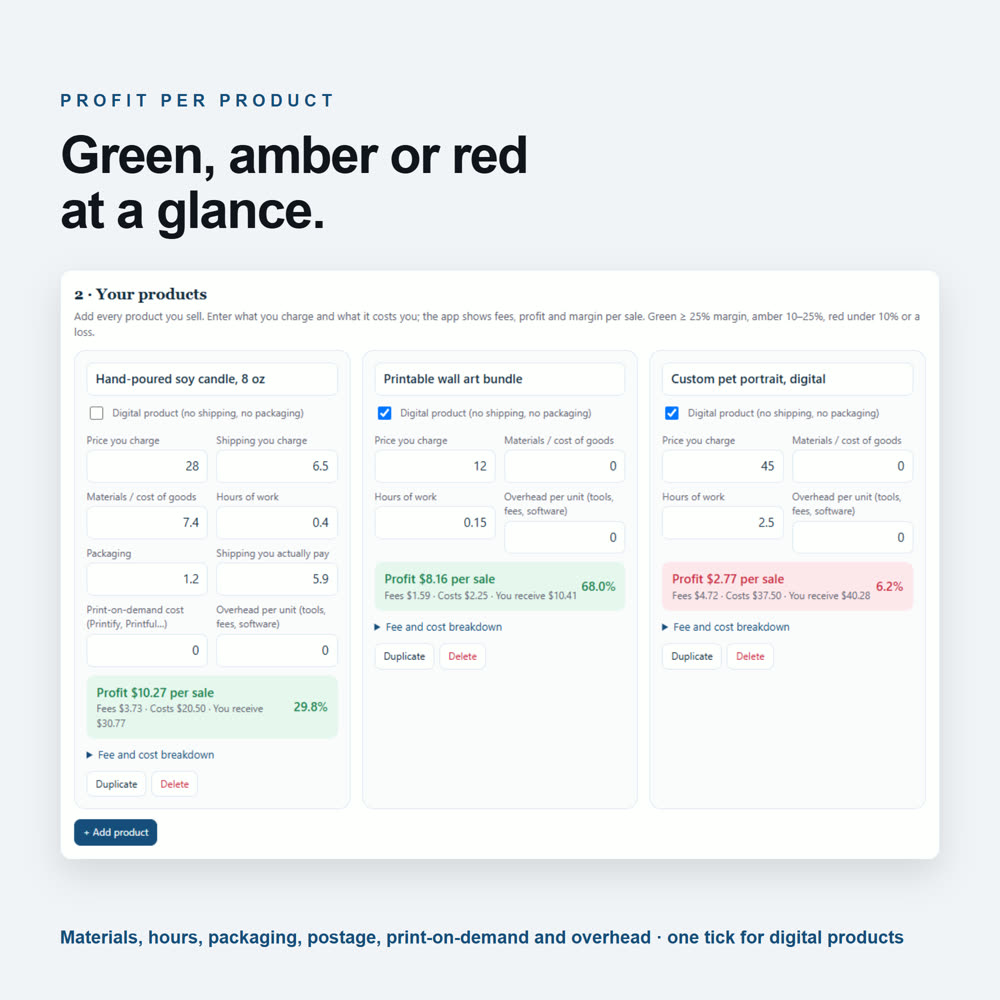
List the money in and the money out
Start with the amount paid for the item. Then write down materials or production, packaging, shipping that you pay, marketplace fees, payment processing and any other cost that belongs to that sale. If the buyer pays shipping separately, include that income and its matching expense too. Use your actual fee statement: percentages and fixed charges can vary by marketplace, country and transaction.
Try one transparent example
Suppose an item sells for $28. Materials cost $9, the shipping you pay is $3 and total fees are $4. The example profit is $28 − $9 − $3 − $4 = $12. The profit margin is $12 ÷ $28 × 100, or about 42.9%. If a fee or refund was omitted, the real result will be different. Taxes and business overhead need their own treatment; this example is not an accounting statement.
Work backwards from a goal
Once you know the costs, decide what profit you need per order and test a price that leaves room for it. Change one assumption at a time: the fee profile, shipping cost or target margin. Fee & Price Calculator lets you set a country fee profile, compare costs and use a price finder. The free demo uses fictional sample data, so replace them with your own figures before relying on a result.
Review the final price in the context of your market and customer. A calculation shows the arithmetic; it cannot promise that a product will sell.